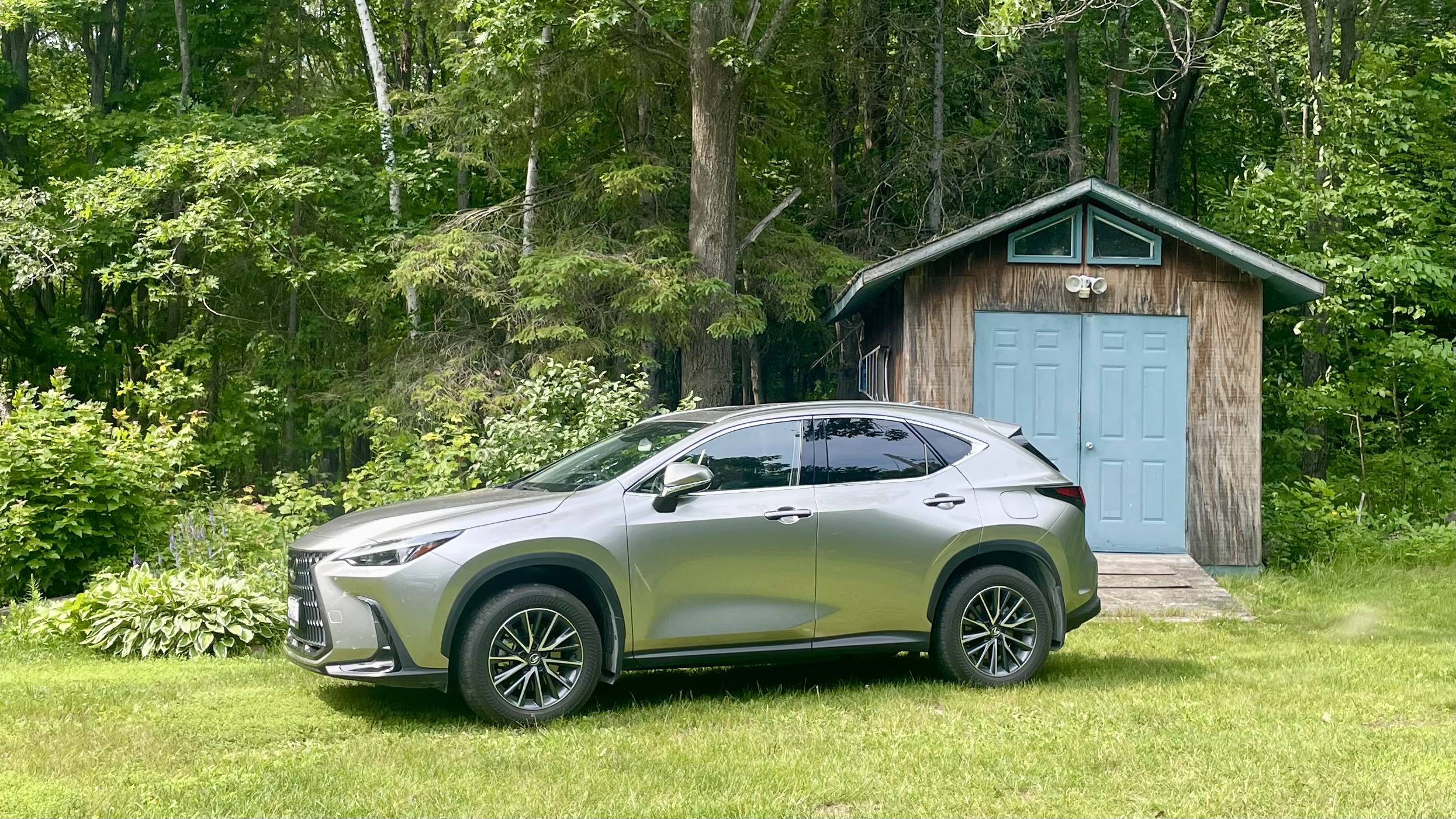
I purchased a new Lexus NX450h+ in March 2025 after 13 months on a wait list. This long wait gave me a lot of time to research and reconsider the vehicle. One of the things that bothered me was the lack of detailed information from real owners, along with incorrect information being parroted by uninformed consumers. People would often discuss how the EV part of the vehicle worked in “cold” environments without any qualifiers.
I live in Manitoba, Canada, which has very extreme temperature variations. In winter, our lows drop to -40°C (-40°F), and our record high in the summer is 40°C (104°F). When people are discussing “cold” performance and behavior of the vehicle, we are talking about different degrees of cold (literally), and that matters a lot for how this car actually functions. So I am going to take some time to share my experience in all conditions, and give some real efficiency numbers for other owners or people considering purchasing the vehicle. I will also mention that this vehicle shares a lot with the 5th-generation Toyota RAV4 (2018–2025), and much of this information probably applies to both.
Value
I think it’s difficult to discuss this SUV without talking about value. Most buyers will be interested to know if paying extra for the Plug-in Hybrid Electric Vehicle (PHEV) model is worthwhile. This is a very complicated question. The cost of the vehicle depends on region, options, and incentives from dealers or governments. Fuel savings will depend on electricity prices, gas prices, driving habits, and climate.
Your situation will be different than mine, but here in Manitoba, energy is provided by a provincially owned corporation with very low-priced electricity (9.97¢/kWh CAD or 7.21¢/kWh USD) and very low emissions because 97–99% of electricity is generated from hydroelectric stations. Manitoba also has an electric vehicle rebate program offering a $4,500 rebate for this model.
In Canada, we somehow have an amazingly well-equipped base model that is about the same price as the U.S. base model before currency conversion. The Canadian base model NX 450h+ includes AWD, a 14” screen, heated steering wheel and seats, and a 6.6 kW charger. The Canadian model’s sticker price, with no room for negotiation, is around $64,000 CAD, while the American version is $60,000 USD but with more room to haggle. Converted to CAD, $60,000 USD is about $83,000. So the value proposition of this vehicle is much better if you are shopping for the base model in Canada. I’ll go into the numbers shortly, and we’ll revisit the value question at the end.
The other important factor to consider is how long you plan on keeping the vehicle. A PHEV has a higher upfront cost but offers savings over time. The longer you own the vehicle, the more you should save. My last car lasted 18 years before being written off in a no-fault collision, and I plan on keeping this one for as long as possible.
Raw data
My Electric Vehicle Supply Equipment (EVSE, a.k.a. EV charger) is connected to a smart plug in my garage. This smart plug can measure wattage and logs the information on my Home Assistant server. When I refuel with gasoline, I manually log the litres, price, odometer reading, and also the number of kilowatt-hours (kWh) my vehicle used during that refueling period. I keep it all in a table presented below:
| Date | Odo | kWh | Litres | $/100km | Effective Fuel Consumption |
|---|---|---|---|---|---|
| 2025-03-24 | 12 km | 0 kWh | 0 L | ||
| 2025-05-18 | 2,564 km | 514 kWh | 40 L | $4.07 | 1.58 L/100km |
| 2025-06-26 | 4,151 km | 252 kWh | 24 L | $3.28 | 1.51 L/100km |
| 2025-06-28 | 4,852 km | 0 kWh | 38 L | $7.28 | 5.40 L/100km |
| 2025-07-02 | 5,612 km | 0 kWh | 43 L | $7.29 | 5.68 L/100km |
| 2025-07-11 | 6,304 km | 0 kWh | 19 L | $3.48 | 2.71 L/100km |
| 2025-07-12 | 6,984 km | 0 kWh | 39 L | $7.30 | 5.75 L/100km |
| 2025-07-14 | 7,706 km | 8 kWh | 42 L | $7.74 | 5.88 L/100km |
| 2025-08-30 | 10,055 km | 366 kWh | 46 L | $4.17 | 1.94 L/100km |
| 2025-11-22 | 13,871 km | 740 kWh | 39 L | $3.08 | 1.02 L/100km |
| 2025-12-05 | 14,800 km | 136 kWh | 36 L | $5.90 | 3.91 L/100km |
| 2025-12-15 | 15,532 km | 73 kWh | 47 L | $8.52 | 6.37 L/100km |
| 2026-01-18 | 16,641 km | 274 kWh | 48 L | $7.80 | 4.35 L/100km |
| 2026-02-28 | 17,811 km | 291 kWh | 47 L | $7.82 | 4.00 L/100km |
| 2026-03-24 | 18,442 km | 205 kWh | 11 L | $6.05 | 1.74 L/100km |
Note that the final fill-up is hypothetical, and I haven’t actually purchased gas since the recent increase. I wanted to provide a full year of data. Also, at the end of June, I went on a 3,500 km road trip. I was able to get a few recharges during that time but was unable to capture the kilowatt-hours in the table.
What is the cost?
People will often talk about fuel efficiency using terms like MPG or L/100 km, or EV driving using kWh/100 km. These are useful but can be difficult to interpret. I prefer to think in terms of $/100 km. This metric considers the mix of energy types along with the local costs of energy.
For me, it averaged $5.10 CAD/100 km based on combined electricity and fuel costs, with a minimum of $3.28 and a maximum of $8.52 during my first year of ownership. This metric makes it very easy to compare to other vehicles. For example, the normal NX hybrid (350h) gets 6 L/100 km combined city/highway according to Natural Resources Canada. If I multiply 6 L/100 km by my average $/L, I get $7.71/100 km. Over the 18,442 km I drove during the first year, I saved $481.21.
Considering the NX 450h+ was actually cheaper than the 350h with the government rebate, I am already ahead. Using the same calculations, I can see I have saved about $1,400 compared to the NX 350 and $1,050 compared to the NX 250. If the next four years are like the first, I will be ahead of every other NX trim. You can also compare against other makes and models the same way. This is a very conservative estimate because I am comparing real-world numbers, including winter driving with winter fuel blends, to fuel efficiency tests conducted in ideal scenarios.
Winter performance
There is a tremendous amount of incorrect information about the behavior of this vehicle in cold weather, so let me try to clear it up. The first thing to understand is traction battery conditioning. While the car is connected to an external power source, the traction battery will be maintained at the correct operating temperature. This is important because you can hop in the car on a cold day, if it has been plugged in, and drive away under EV power, but if you do the same after work when the car has not been plugged in, the internal combustion engine (ICE) will start instead. I am not exactly sure what the exterior temperature threshold is for the battery being too cold, but it seems to be around -10°C (14°F) or colder.
This SUV has a heat pump to efficiently warm the cabin by drawing thermal energy from the outside air. The heat pump will operate down to about -11°C (12°F). If the temperature drops lower and you have the cabin heat on, the ICE will start. In these situations, the ICE will run until the cabin reaches the selected temperature, then turn off and return to EV power until heat is needed again. During very cold driving, like -30°C and below, the ICE will run most of the time. I will also note that while the heat pump works down to -11°C, it becomes pretty ineffective around -8°C. If you want to force the ICE on, pressing the front defrost button will always do so.
If your traction battery is already at operating temperature (usually from being plugged in before driving), you can operate the vehicle in pure EV mode in very cold temperatures as long as you turn off the cabin heater. This might sound extreme, but my office is only an 8-minute drive from my home. For me, it’s not worth turning on the heat because the cabin won’t warm up much anyway. I also get enough warmth from the heated seats and steering wheel. This lets me avoid running a very cold and very short cycle on the ICE.
The main issue with this approach is that the climate control system has no way to run the fans without also calling for heat. At extremely cold temperatures, your breath will quickly fog the windows, which can be hazardous. Ideally, a software update would allow more granular climate control. If you could run the fans alone, cold dry air moving over the glass would quickly clear condensation. In the meantime, I crack a window slightly to get airflow, which works as long as the vehicle is moving.
I have one final note about cold weather performance: freezing rain. Twice, while operating the vehicle around -8°C (18°F) with the heat pump providing cabin heat, I encountered freezing rain that immediately froze on the windshield. In both cases, I pressed the front defrost button to get maximum heat, but starting from a cold engine meant waiting a few minutes for heat to build. In one case, I had to pull over due to poor visibility and wait until I could see clearly again. Winter washer fluid didn’t help much without sufficient heat. If freezing rain is expected, it’s best to keep the engine warm, but that’s not always something you can anticipate.
Service history
Not much has been done to the vehicle. I had one oil change, purchased four Nokian Hakkapeliitta R5 SUV tires on steel rims (foregoing the surprisingly expensive tire pressure monitors), and installed a Draw-Tite Class 3, 2” trailer hitch for a bike rack. The tires have been excellent. I struggled a bit installing the hitch, and it hangs slightly low, but it hasn’t caused any issues.
Final thoughts
Overall, I am very happy with the vehicle after the first year. I really like the flexibility of driving around the city in EV mode, while still being able to travel long distances easily.
In my specific situation, it makes a lot of sense but for many people, it won’t. If you live somewhere with higher electricity costs, higher vehicle prices, mostly do long-distance driving, or tend to switch vehicles every 3–5 years, this type of vehicle becomes less attractive. Even with better pricing in Canada, it can be hard to justify the upfront cost without incentives.
It’s easy to say you’ll break even in 10 years but are you factoring in interest or opportunity cost? That said, some people choose vehicles like this to reduce their carbon emissions, which is a perfectly valid goal.
Finally, the stock run-flat tires are not great, and I’m looking forward to replacing them when they wear out.